
The Property Owner's Playbook for Commercial Real Estate Investment in Atlanta

Commercial real estate investment in Atlanta can build long-term wealth, produce recurring income, and help protect capital when investors focus on durable property performance. Local demand across industrial, retail, office, and specialized commercial space creates opportunities for owners who understand tenant quality, lease structure, operating costs, and future capital needs.
This practical playbook is designed for investors, property owners, and business leaders who want to buy, grow, or upgrade a commercial portfolio with a clear plan. The objective is not simply to acquire a building, but to own an asset that can support dependable income, measured growth, and a disciplined exit strategy.
Commercial Real Estate Investment in Atlanta: 4 Ways to Boost Property Returns
Commercial real estate investment in Atlanta can improve when owners raise sustainable income, reduce avoidable costs, use debt carefully, and protect occupancy.
Adding Value & Increasing Rent
Property improvements can strengthen tenant appeal and support better leasing results. Updated lighting, signage, parking areas, common spaces, access points, and deferred maintenance can make a building more competitive. Owners should also review current rents, lease expirations, and renewal terms to identify space that may be priced below comparable options.
Cutting Extra Costs with NNN Leases
NNN leases can shift certain maintenance, property tax, and insurance responsibilities to tenants. Clear lease language should define reimbursements, repair obligations, annual reconciliations, and capital responsibilities so owners understand the income remaining after operating expenses.
Smart Financing & Loan Strategies
Financing should support cash flow rather than create pressure at lease rollover or maturity. Compare interest-rate structure, loan term, reserve requirements, prepayment provisions, future capital needs, and tenant lease duration before selecting debt for a commercial property.
Securing Great, Long-Term Tenants
Reliable tenants can reduce vacancy risk, turnover costs, and income disruption. Review a tenant's business strength, permitted use, lease term, renewal prospects, and replacement costs before treating projected rent as dependable long-term income.
Commercial Real Estate Investment in Atlanta: Comparing Property Types
Atlanta commercial property types differ in income stability, operating demands, and the factors that influence tenant demand.
| Property Type | Income Stability | Key Demand Drivers | Main Ownership Considerations |
|---|---|---|---|
| Industrial & Warehouses | Often stable when the building is functional and well located | Loading access, clear height, truck circulation, parking, and transportation access | Review building systems, tenant improvements, site layout, and deferred maintenance |
| Retail & Shopping Plazas | Can be dependable with a balanced tenant mix | Visibility, access, parking, customer traffic, and anchor tenant strength | NNN leases may recover expenses, while turnover and co-tenancy terms can affect income |
| Office & Flex Buildings | Varies based on layout, location, and tenant needs | Flexible floor plans, parking, technology, access, and common areas | Leasing can take longer and may require renovation or repositioning |
| Medical & Healthcare Real Estate | Often supports longer occupancy when the space fits provider needs | Patient access, parking, specialized layouts, and nearby services | Specialized interiors can increase costs but may encourage retention |
Smart Tax Moves and Exit Strategies for Atlanta Property Owners
Tax planning and a disciplined exit strategy can help commercial owners retain more value.
-
1031 Exchanges: A properly structured 1031 like-kind exchange may defer recognition of certain taxable gain when an investor exchanges qualifying real property held for business or investment for qualifying replacement real property. Strict identification and closing deadlines apply.
-
Tax Savings Through Depreciation: Depreciation allows owners to recover qualifying property costs over time. IRS Publication 946 explains depreciation rules for business and income-producing property. Cost segregation may change the timing of deductions when used with qualified tax guidance.
-
Deciding When to Hold or Sell: Compare lease rollover, income durability, capital needs, financing, and expected sale proceeds. Owners should measure current returns against the work, risk, and investment required to maintain or improve the property.
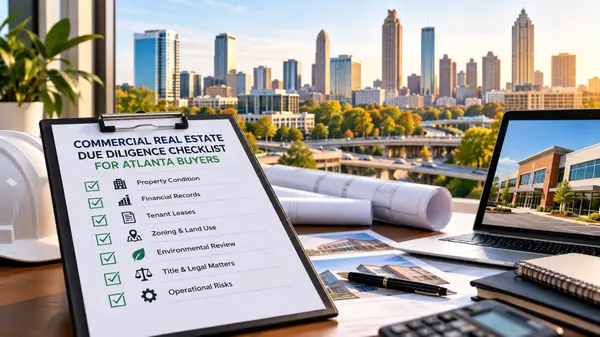
Pro-Tip: Before making an offer, request the rent roll, active leases, operating statement, and maintenance history, then verify lease terms, renewal options, rent escalations, reimbursements, security deposits, and recurring owner-paid expenses. Review records for the roof, HVAC, paving, plumbing, electrical, life-safety systems, and deferred repairs, then evaluate Atlanta cap rates only after confirming that NOI reflects actual collections, sustainable occupancy, normalized expenses, vacancy, leasing costs, replacement reserves, and likely capital needs. A higher cap rate may reflect greater tenant, location, lease-duration, or building-condition risk rather than a better investment.
Commercial Real Estate Investment in Atlanta: Direct Ownership vs. Co-Investing
Direct ownership provides more control, while co-investing can reduce daily responsibilities and expand access to larger commercial assets.
| Consideration | Direct Property Ownership | Co-Investing & Real Estate Partnerships |
|---|---|---|
| Control | You control tenants, lease terms, upgrades, financing, and sale timing | A managing partner or ownership group handles decisions under the agreement |
| Income and equity | You retain cash flow, tax deductions, and long-term equity growth | Profits, deductions, and appreciation are shared under ownership terms |
| Management | Requires oversight of leasing, maintenance, reporting, and vendors | Can be more passive, but still requires review of the manager and agreement |
| Property access | May limit acquisitions to available capital and borrowing capacity | Can provide access to larger or more complex commercial assets |
| Key risk | Vacancy and capital needs can be concentrated in one property | Shared outcomes and reduced control require careful review of fees and exit rights |
Danesha Ritzberg helps real estate investors and business owners identify off-market opportunities, review lease quality, test operating assumptions, and compare direct ownership, partnerships, value-add plans, and stabilized-income strategies across Atlanta, Cobb County, Douglas County, Fulton County, and Paulding County.
When evaluating Atlanta industrial and warehouse real estate options or other commercial assets, evaluating commercial property returns means looking beyond the asking price. A disciplined review analyzes tenant strength, NNN expense recoveries, financing fit, lease rollover exposure, deferred maintenance, and capital needs before committing capital.
Reach out directly at +1 404-853-8619 or visit the contact page for an easy, no-pressure chat about your commercial investment goals.
Frequently Asked Questions
What is a good Cap Rate for commercial property in Atlanta?
A good cap rate depends on the property type, location, tenant quality, lease structure, condition, and risk level. Prime buildings with stable income often have lower cap rates, while older properties or value-add opportunities may require higher returns to account for leasing, repair, or operational uncertainty.
How do I figure out Net Operating Income (NOI) for a commercial building?
NOI is the income remaining after annual operating costs are subtracted from total rental income and other property revenue, before debt service and income taxes. Include property taxes, insurance, repairs, management, owner-paid utilities, and routine operating costs when calculating the result.
What is a 1031 exchange and how does it help property owners?
A 1031 exchange may defer recognition of certain taxable gain when an investor exchanges qualifying real property held for business or investment for qualifying replacement real property. Strict identification and closing deadlines apply, so owners should coordinate early with qualified tax and exchange professionals.
Why do commercial investors like Triple Net (NNN) leases so much?
NNN leases are attractive because tenants may pay or reimburse property taxes, insurance, and certain maintenance costs. This can make owner income more predictable, although the agreement should clearly define reimbursable expenses, repair obligations, limits, and each party's responsibilities.
Should I work with a commercial real estate broker to buy investment property?
A commercial specialist can help investors locate less-visible opportunities, verify building income and lease information, and negotiate terms that support the investment plan. Professional guidance can also clarify tenant risk, operating costs, financing considerations, and future capital requirements.
Categories
Recent Posts






"My job is to find and attract mastery-based agents to the office, protect the culture, and make sure everyone is happy! "