
Office Space Trends in Atlanta: Class A vs. Class B vs. Class C Buildings
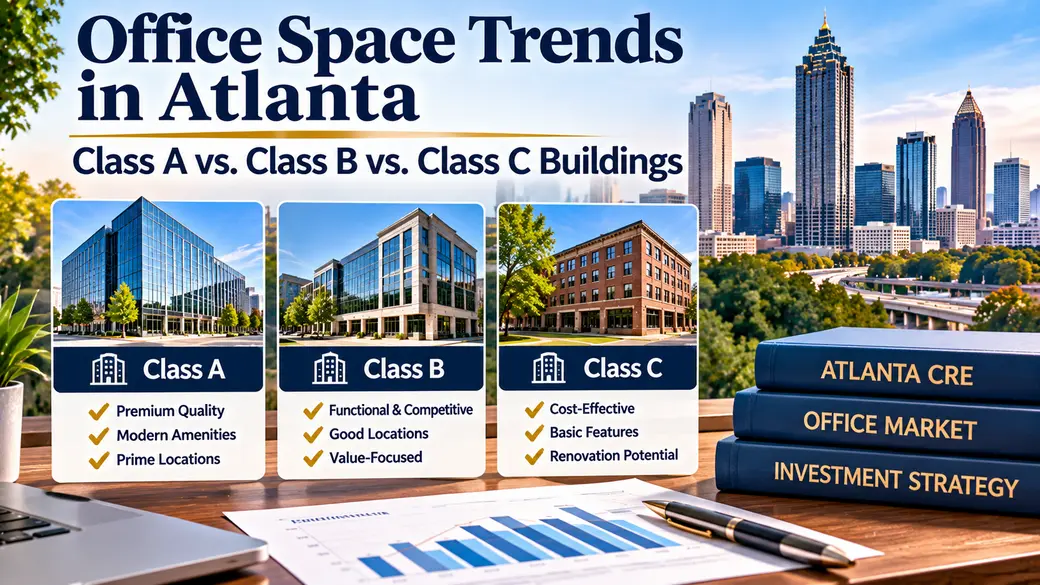
In Atlanta, Class A offices prioritize premium amenities and image, Class B offices balance functionality and cost, and Class C offices suit users willing to trade newer systems and amenities for lower occupancy costs. Office space trends in Atlanta matter because businesses and investors are weighing building quality, location, operating costs, accessibility, and tenant demand more carefully. These classifications serve different budgets, workplace needs, and investment objectives. Selecting a building requires more than comparing rental quotes or judging the lobby. Building systems, lease structure, maintenance exposure, and the immediate submarket can materially influence total value.
Understanding Class A, Class B, and Class C Office Buildings
Office building classes are relative market categories that describe a property’s quality and competitive position. The Building Owners and Managers Association class definitions consider factors including rent, finishes, building systems, amenities, location, accessibility, and market perception.
These labels are not legal designations or permanent grades. A building’s classification may vary with local competition, property condition, recent improvements, and the organization assigning the rating. For tenants, class helps frame likely workplace experience and occupancy costs. For owner-occupants and investors, it provides context for tenant demand, capital needs, and competitive risk.
What Is Class A Office Space in Atlanta?
Class A office space in Atlanta generally includes buildings competing at the highest level of their local submarket. These properties often combine premium finishes, modern lobbies, strong building systems, professional management, accessible locations, and amenities designed to support employees and visitors. Features can include advanced HVAC, security services, conference facilities, fitness areas, convenient parking, and transit access.
Larger companies, professional service firms, and businesses focused on employee experience or client presentation often consider Class A space. These buildings commonly compete at higher rental levels than nearby alternatives, but the advertised rate is only one part of the decision. Tenants should also compare concessions, operating expenses, tenant improvement allowances, parking, and the full occupancy commitment. Class A properties do not all provide identical services, finishes, or lease economics.
What Defines a Class B Office Building?
Class B office buildings generally offer functional, competitive space at rental levels closer to the market average. They may provide good finishes, dependable systems, professional management, and useful locations without every premium feature associated with top-tier properties.
Established local businesses, growing companies, professional offices, and owner-occupants may find Class B space well aligned with a value-focused strategy. Some buildings are older but carefully maintained, while others have been renovated to improve their competitiveness. Parking availability, accessibility, mechanical condition, flexible floor plates, and responsive management all influence the tenant experience. Class B is not automatically an inferior option. A well-located, updated Class B building can create a practical balance of image, functionality, and cost for the right operation.
What Is Class C Office Space?
Class C office space generally competes for tenants seeking functional premises at below-average market rental levels. These buildings may have older systems, basic finishes, fewer shared amenities, or greater maintenance and modernization needs than higher-class alternatives.
Cost-conscious businesses and investors considering renovation opportunities may evaluate Class C properties when the location and layout fit the intended use. However, a lower rent or purchase price does not automatically create better value. Deferred maintenance, accessibility limitations, energy efficiency, insurance costs, and future capital improvements can change the overall economics. Some Class C buildings can serve business needs effectively when they are well maintained and suited to the operation. The key is evaluating the building’s actual condition and future obligations rather than relying on its label alone.
Class A vs. Class B vs. Class C Office Buildings: Key Differences
Building class is a helpful starting point, but each office property should be evaluated on its individual merits.
| Comparison Factor | Class A Office | Class B Office | Class C Office |
|---|---|---|---|
| Overall Building Quality | Top competitive quality in its submarket | Functional, professional quality | Basic, often more dated quality |
| Typical Market Position | Premium tier | Middle-market or value-oriented tier | Lower-cost competitive tier |
| Rental Cost Positioning | Generally higher | Often near market average | Typically below average |
| Building Systems and Maintenance | Modern systems and proactive upkeep | Adequate systems with varying upgrades | Older systems or greater upgrade needs |
| Common Amenities | Extensive workplace and visitor amenities | Useful but more limited shared amenities | Few amenities or basic services |
| Location and Accessibility | Highly desirable or well-connected setting | Good access, depending on property | Varies by individual property |
| Likely Tenant Priorities | Image, amenities, talent experience | Functionality, value, flexibility | Affordability and practical use |
| Potential Improvement Needs | Usually limited, though not absent | Selective updates may improve competitiveness | Often greater modernization needs |
| Ownership and Investment Considerations | Higher capital and operating expectations | Potential for targeted repositioning | Higher repair and leasing risk |
Building class alone does not determine whether an office is the right fit. Location, condition, lease structure, systems, and business requirements remain essential parts of the comparison.
Office Space Trends in Atlanta: What Q3 2025 Market Data Showed
In Q3 2025, aggregated commercial listing data for the Atlanta office market recorded 26.5% overall office vacancy, with Class A space posting positive net absorption and Class B space posting negative net absorption. Those figures describe a historical period, not every building’s present performance.
The quarter illustrated how hybrid work and changing workplace requirements can affect office demand. Tenants often placed greater emphasis on efficient layouts, collaboration space, building quality, convenient parking or transit, and amenities that support in-person work.
Older properties may need refreshed common areas, improved systems, or repositioning plans to remain competitive. Demand can differ substantially between Midtown, Buckhead, Central Perimeter, and suburban locations because tenant profiles, nearby alternatives, and access patterns are not the same across the market. Leasing decisions also depend on floorplate efficiency, move-in timing, tenant improvement needs, and whether a building’s services support the way a business expects employees to use the office.
Office Space Trends in Atlanta - Is Class A Always More Expensive?
Class A office space typically commands higher asking rents than Class B and Class C alternatives in the same competitive area, but the posted rent is not the complete occupancy cost. Tenants should compare base rent with operating-expense pass-throughs, common area maintenance charges, utilities, parking fees, tenant improvements, and negotiated concessions.
Lease structure also changes the financial picture. A full-service gross lease may include more building expenses in the quoted rate, while modified gross and net leases can shift certain expenses to the tenant. For example, a hypothetical $30-per-square-foot quote with substantial pass-throughs could cost more overall than a $34 quote that includes more services. Businesses should compare the total annual commitment, included services, and operational fit rather than selecting space solely because it has the lowest advertised rate.
Property taxes are another important consideration when evaluating the total cost of office space in Atlanta. For commercial property owners, a reassessment can affect annual operating expenses, while tenants may see changes in their costs depending on how the lease allocates property taxes. Before comparing Class A, Class B, and Class C buildings, explore our guide to how commercial property reassessments affect Atlanta ownership costs to better understand how taxes may influence your long-term budget.
Office Market Differences Across Atlanta Submarkets
Atlanta office conditions differ by submarket because business environments, access patterns, building inventory, and tenant expectations vary. Midtown Atlanta has a dense urban employment and institutional environment, while Downtown Atlanta offers proximity to civic, educational, and business destinations. Buckhead remains a prominent business district with office, retail, hospitality, and residential activity.
Central Perimeter provides access to a major business concentration and transportation connections. North Fulton and Alpharetta can appeal to businesses seeking suburban access, parking, and proximity to northern employment centers. Transit access may be a deciding factor for some users, and MARTA’s rail and bus network is part of that location analysis. Each area contains a mix of building types and competitive conditions. A property’s value depends on its immediate surroundings, tenant alternatives, access, and physical condition, not on a metro-wide class label.
Which Office Building Class Is Better for Business Owners and Tenants?
The best office building class is the one that supports a company’s budget, operations, and growth plans. Businesses should weigh monthly occupancy costs, employee accessibility, parking, space configuration, client-facing needs, expansion potential, and maintenance responsibilities before choosing a property.
Class A may suit organizations prioritizing amenities and a premium workplace environment. Class B can provide a strong balance of functionality, location, and cost. Class C may work for cost-conscious operations when the property condition, systems, and operational requirements are acceptable. Before committing, tenants should review lease terms, improvement requirements, expense obligations, and renewal exposure. Available Atlanta commercial properties can be compared against the company’s preferred location, space needs, and total occupancy budget.
What Office Building Classes Mean for Commercial Property Investors
Office building classifications influence investment analysis because they affect tenant demand, vacancy exposure, capital requirements, operating expenses, and repositioning potential. A Class A property may attract tenants seeking premium space, but it can also require substantial acquisition capital and ongoing investment in management, systems, and amenities.
Class B buildings may offer upgrade or repositioning opportunities when location, demand, and project economics support improvements. Class C properties can involve greater repair, tenant improvement, modernization, and leasing risk. Investors should assess the property's actual competitive position rather than simply relying on its marketing label. Classification does not guarantee appreciation, stable income, or future performance. A thorough review of leases, building condition, operating history, and local alternatives is essential. Before committing to a property, use this commercial real estate due diligence checklist for Atlanta buyers to identify potential risks and evaluate the investment more thoroughly.
What to Evaluate Before Leasing or Buying Office Space in Atlanta
A disciplined comparison should focus on the property’s practical performance as well as its classification.
| Evaluation Factor | Questions to Ask | Why It Matters |
|---|---|---|
| Building Classification and Condition | Does the current condition match the stated class? | Identifies competitive position and upgrade exposure |
| Total Rental or Acquisition Cost | What costs extend beyond the quoted rate or price? | Clarifies the full financial commitment |
| HVAC and Mechanical Systems | What is the age, condition, and responsibility for key systems? | Helps anticipate operating reliability and capital needs |
| Parking and Transportation Access | Is access convenient for employees and visitors? | Affects daily usability and tenant appeal |
| Lease Terms or Ownership Restrictions | What obligations, limits, or renewal terms apply? | Reduces unexpected operational constraints |
| Building Amenities and Layout | Does the space support current workflows and meetings? | Connects the property to business needs |
| Maintenance and Renovation Requirements | What improvements are needed now or later? | Reveals potential capital exposure |
| Tenant Demand and Location Suitability | Does the setting fit the intended user or tenant base? | Supports leasing and investment decisions |
Pro Tip: Compare the Building's Total Value, Not Just Its Class
Pro Tip: Evaluate condition, location, lease structure, building systems, operating costs, accessibility, and operational fit before treating a building class as a value signal. Class A is not automatically the best value, and Class C is not automatically the lowest-cost solution.
Explore Office Real Estate Opportunities in Atlanta
Commercial real estate opportunities in Atlanta and an opportunity to connect with Danesha Ritzberg can help business owners, tenants, and investors clarify property needs, preferred locations, and budget before narrowing their office options.
Frequently Asked Questions About Office Space in Atlanta
What is the difference between Class A, Class B, and Class C office buildings?
Class A, B, and C labels compare office properties within a local market by condition, location, finishes, systems, amenities, rental positioning, and competitive quality. Class A is generally premium, while Class B and C provide increasingly value-oriented alternatives.
Is Class A office space worth the higher rent?
Class A space may justify a higher cost when its image, amenities, accessibility, and included services advance a company’s goals. Compare total occupancy expenses, parking, concessions, lease obligations, and workplace value rather than the advertised rent alone.
Are Class B office buildings a good investment?
Class B offices can present investment opportunities when property condition, tenant demand, renovation costs, and local positioning support the plan. Investors should still evaluate leasing risk, operating expenses, required upgrades, and nearby competing buildings before proceeding.
Why are some older office buildings experiencing higher vacancy?
Older properties can face higher vacancy when tenants favor modern systems, flexible layouts, stronger amenities, convenient access, and improved workplace environments. Outcomes vary by location and condition, and well-maintained older buildings can remain competitive after targeted improvements.
Which areas of Atlanta have Class A office buildings?
Midtown, Downtown, Buckhead, Central Perimeter, and North Fulton or Alpharetta have established office environments where Class A inventory may be available. Each property’s classification and availability should be confirmed individually because market conditions and building quality can change.
Categories
Recent Posts










"My job is to find and attract mastery-based agents to the office, protect the culture, and make sure everyone is happy! "