
NNN (Triple Net) vs. Gross Leases in : What Commercial Tenants & Landlords Need to Know
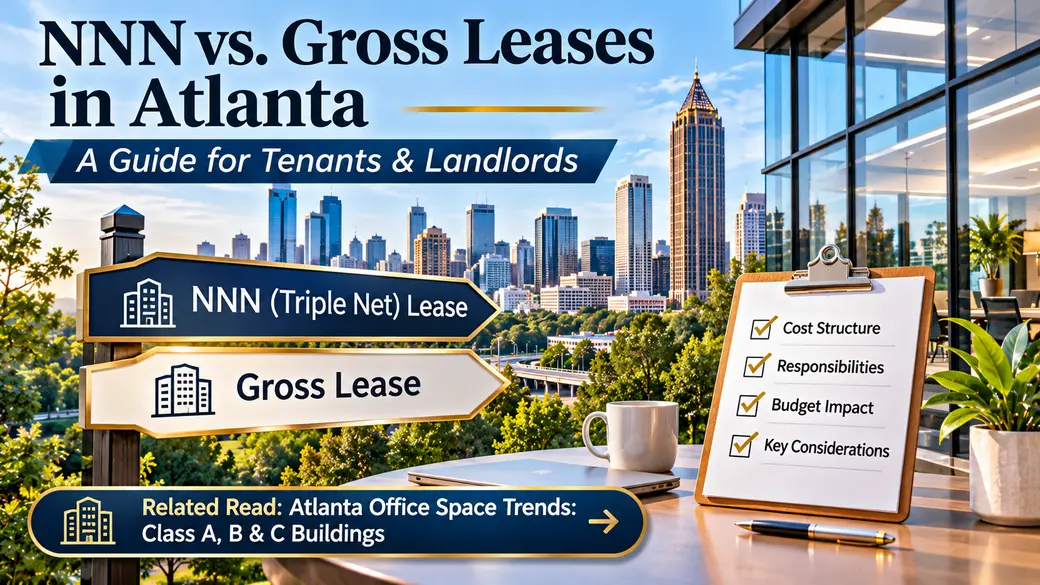
Commercial leases can produce very different total costs even when advertised rent appears similar. In an NNN vs gross lease in Atlanta comparison, the essential issue is how property taxes, insurance, maintenance, and other operating expenses are allocated between tenants and landlords.
For retail, office, and industrial users, comparing base rent alone can create unexpected occupancy costs. NNN, or triple net, and gross leases assign financial responsibilities differently. This practical guide explains the cost structure behind each option so business owners, tenants, and property owners can evaluate proposals with greater clarity.
What Is an NNN (Triple Net) Commercial Lease?
A triple net lease is a commercial lease in which the tenant generally pays base rent plus an allocated share of property taxes, property insurance, and common area maintenance. An NNN commercial lease separates those operating costs from the advertised base-rent figure.
Charges may be estimated and billed periodically, then reconciled against actual expenses under the lease. This approach is common in certain retail, industrial, and single-tenant properties, although individual agreements can vary substantially. Responsibility for utilities, roof repairs, structural work, capital improvements, and other major items depends on the actual contract language. The triple net lease label does not automatically assign every obligation to a tenant or eliminate financial risk for either party.
What Is a Gross Commercial Lease?
A gross commercial lease generally includes many property operating expenses within the tenant's quoted rent, while the landlord pays the expenses specified in the agreement. This can give tenants a more predictable starting point for budgeting because more costs are bundled into one rent figure.
A full-service gross lease may include taxes, insurance, maintenance, and building services, but not every gross arrangement covers every expense. Separately metered utilities, janitorial services, base-year adjustments, expense stops, and other negotiated items can still create additional tenant obligations. Landlords must account for expected operating costs when setting gross rent because expense increases can affect the income remaining after property expenses are paid.
NNN vs. Gross Leases: Key Differences for Tenants and Landlords
| Lease Feature | Triple Net (NNN) Lease | Gross Lease |
|---|---|---|
| Base rent | Typically quoted before operating charges | Typically reflects more included expenses |
| Property taxes | Often reimbursed or paid through a tenant allocation | Often paid by landlord, subject to lease terms |
| Insurance | Often passed through to tenant | Often included, with possible exceptions |
| Common area maintenance | Commonly billed as an additional charge | Often included or partially included |
| Utilities and repairs | Vary by lease and service arrangement | May be included, separately metered, or allocated |
| Expense predictability | Can change when pass-through costs change | Often higher initially, but exceptions may apply |
| Primary financial risks | Tenant may face changing operating charges | Landlord may absorb changing property expenses |
The signed lease controls the actual allocation of costs, services, repairs, and reimbursement obligations.
How NNN and Gross Lease Costs Affect Monthly Rent
Commercial tenants should compare total occupancy costs, not just the advertised rental rate. Those costs may include base rent, additional rent, property-tax reimbursements, insurance, common area maintenance, utilities, and other separately billed items.
NNN lease costs are often quoted as base rent plus commercial lease operating expenses per rentable square foot each year. Dividing the annual total by 12 converts proposals into a working monthly budget. A lower NNN base rent can create recurring obligations beyond the initial quote, while a higher gross figure may include more costs. To compare commercial rent in Atlanta fairly, tenants should use the same rentable area, lease period, included services, escalation assumptions, utility treatment, and expense categories for every proposal.
Comparing the Annual Cost of an NNN Lease and a Gross Lease
| Cost Component | NNN Lease | Gross Lease |
|---|---|---|
| Annual base rent | $48,000 ($24 × 2,000 sq ft) | $72,000 ($36 × 2,000 sq ft) |
| Additional operating charges | $18,000 ($9 × 2,000 sq ft) | Included in quoted rent |
| Total annual occupancy cost | $66,000 | $72,000 |
| Monthly occupancy cost | $5,500 | $6,000 |
This is an illustrative comparison, not current Atlanta rental pricing. Separately metered utilities and other unquoted charges are excluded from both examples.
What Is a Modified Gross Lease, and How Does It Compare?
A modified gross lease is a negotiated commercial arrangement in which the landlord and tenant divide operating expenses according to specified terms. It falls between a full-service gross lease and an NNN structure rather than following one standardized formula.
For example, a lease may use a base year or expense stop, with the landlord covering expenses up to an agreed level and the tenant paying increases afterward. Other agreements allocate utilities, janitorial work, maintenance, or selected taxes separately. Because modified gross terms differ by contract, tenants comparing NNN and full-service gross proposals should identify every expense category rather than relying on the lease label alone.
Which Lease Structure Offers Better Cost Predictability?
Gross leases often provide greater initial budgeting certainty for tenants because more operating costs are included in the quoted rent. A triple net vs gross lease comparison can shift that conclusion when a gross lease contains expense stops, annual increases, or excluded services.
Under an NNN arrangement, changes in property taxes, insurance premiums, maintenance needs, and operating budgets may affect tenant payments. Under a gross lease, those changes can affect landlord cash flow unless the agreement permits recovery through escalations or reimbursements. Estimated expense payments and annual reconciliations can also change the final amount due. Expense caps may limit certain controllable commercial lease expenses, but neither lease structure removes financial risk entirely for either side.
NNN vs. Gross Leases for Retail, Office, and Industrial Properties
Lease structures can differ by property type, ownership strategy, building operations, and negotiated terms. In Atlanta, NNN arrangements are frequently associated with certain retail storefronts, industrial facilities, and warehouse properties, where tenants may reimburse a share of taxes, insurance, and common-area costs.
Some multi-tenant office buildings use full-service or modified gross terms because the landlord centrally manages shared services and facilities. Parking, common areas, HVAC responsibilities, utilities, security, and building amenities can all affect final expense allocation. A warehouse user may have different utility and maintenance needs than a professional office tenant. The suitable structure depends on the space, business operations, and written contract, not the property category alone.
When comparing office properties in Atlanta, building classification can also influence lease expectations, operating expenses, and the amenities included in rental agreements. Class A, Class B, and Class C offices may differ in their maintenance requirements, shared services, and overall occupancy costs. For a closer look at these differences, explore our breakdown of Atlanta office building classifications and market trends before evaluating your next lease.
How Commercial Lease Terms Differ Across Atlanta Submarkets
Commercial lease structures can vary across Atlanta business districts, suburban retail areas, office corridors, and industrial markets. Midtown, Buckhead, Downtown, Central Perimeter, and established Metro Atlanta retail or industrial corridors may present different building formats, tenant mixes, and management practices.
Newer properties or buildings with extensive shared amenities may use operating-expense arrangements that differ from older standalone facilities. A multi-tenant office property may centralize services, while an industrial site may assign more direct utility or maintenance responsibilities. Retail properties can also differ based on common-area features, parking arrangements, and landlord management practices. The key comparison is not the submarket name, but the expense language, services, and obligations attached to each proposed space.
What Commercial Tenants Should Review Before Signing a Lease
Commercial tenants should review every financial obligation in the proposed lease before signing. Confirm base rent, estimated additional rent, CAM definitions and exclusions, utility responsibilities, maintenance requirements, security deposits, renewal terms, escalations, and annual expense reconciliations.
Ask whether charges are paid directly to providers or reimbursed to the landlord. Review audit rights, limits on controllable operating-expense increases, and the treatment of capital expenditures. A lower advertised rent may not create a lower total occupancy cost. Businesses should review commercial permitting requirements before signing a lease in Atlanta when the intended use requires local approvals. Qualified legal counsel can provide contract-specific guidance before either party commits to the agreement.
What Landlords Should Consider When Choosing a Commercial Lease Structure
Commercial landlords should select a lease structure based on operating costs, management responsibilities, tenant demand, expense recovery, and projected net rental income. NNN leases may support clearer expense recovery, while gross leases can simplify tenant budgeting and marketing for certain spaces.
The lease should clearly address maintenance, repairs, tax changes, insurance obligations, reconciliations, and capital expenditures. Landlords also need to consider how the structure fits the property type and the expectations of prospective tenants. A lease label alone does not guarantee profitability or eliminate management demands. Owners should weigh commercial real estate investment considerations in Atlanta alongside the property's operating history, tenant profile, and leasing strategy.
Commercial Lease Cost Review Checklist
| Lease Review Item | What to Confirm | Why It Matters |
|---|---|---|
| Base rent | Rate, rentable area, payment schedule | Establishes the starting cost |
| Property tax obligations | Direct payment or landlord reimbursement | Identifies tax exposure |
| Insurance payments | Required coverage and pass-through method | Clarifies recurring charges |
| CAM charges | Included items, exclusions, allocation method | Prevents unclear shared-cost billing |
| Utilities | Metering, service responsibility, billing method | Avoids unexpected monthly expenses |
| Maintenance and repairs | Interior, exterior, HVAC, structural obligations | Defines operational responsibility |
| Escalations or reconciliations | Increase formula, caps, timing, audit rights | Measures future payment variability |
| Renewal or termination terms | Notice dates, options, fees, conditions | Supports long-term planning |
Pro Tip: Compare Total Occupancy Costs Before Choosing a Lease
Pro Tip: Compare written total occupancy-cost estimates for the same space and lease period instead of relying only on base rent. Review prior operating-expense statements where available, future escalation provisions, and possible CAM reconciliation charges. These details can reveal meaningful differences between NNN and gross lease proposals before either party commits.
Find the Right Commercial Space in Atlanta
The right commercial space is one whose location, physical requirements, and written lease obligations support the business plan over the intended lease period. When comparing an NNN vs. gross lease in Atlanta, evaluate total occupancy cost and the documented allocation of operating expenses rather than base rent alone.
Danesha Ritzberg of Ritzberg Realty Commercial Real Estate helps business owners, tenants, and property investors evaluate commercial real estate opportunities in Atlanta and lease considerations. To discuss space requirements, proposed terms, and financial assumptions, let's discuss your commercial property goals.
Frequently Asked Questions About NNN and Gross Commercial Leases
What is the main difference between an NNN lease and a gross lease?
The primary difference is how operating costs are assigned. NNN terms usually place specified tax, insurance, and maintenance charges on the tenant in addition to rent, while gross terms generally bundle more designated costs into the quoted rent.
Is a triple net lease cheaper than a gross lease?
Not automatically. A triple net lease may advertise a lower base rate, but recurring tax, insurance, CAM, and utility obligations can raise the total. Compare fully loaded occupancy costs for the same space, services, and lease period.
Who pays property taxes under an NNN lease?
Under many NNN agreements, tenants pay or reimburse an allocated portion of property taxes. The lease should identify the allocation method, payment timing, exclusions, and whether estimated tax charges are reconciled against actual obligations.
Can a gross lease include additional charges?
Yes. Gross leases may still include base-year adjustments, expense stops, separately metered utilities, after-hours services, or negotiated charges. Tenants should identify which services are included and which costs remain separately payable before comparing proposals.
Which commercial lease is better for landlords?
The appropriate structure depends on property type, tenant demand, operating expenses, management capacity, and preferred risk allocation. NNN terms can strengthen expense recovery, while gross terms may offer prospective tenants a simpler initial budgeting framework.
Categories
Recent Posts










"My job is to find and attract mastery-based agents to the office, protect the culture, and make sure everyone is happy! "