
SBA 504 vs. Conventional Commercial Loans in Atlanta: Which Is Better for Business Owners?
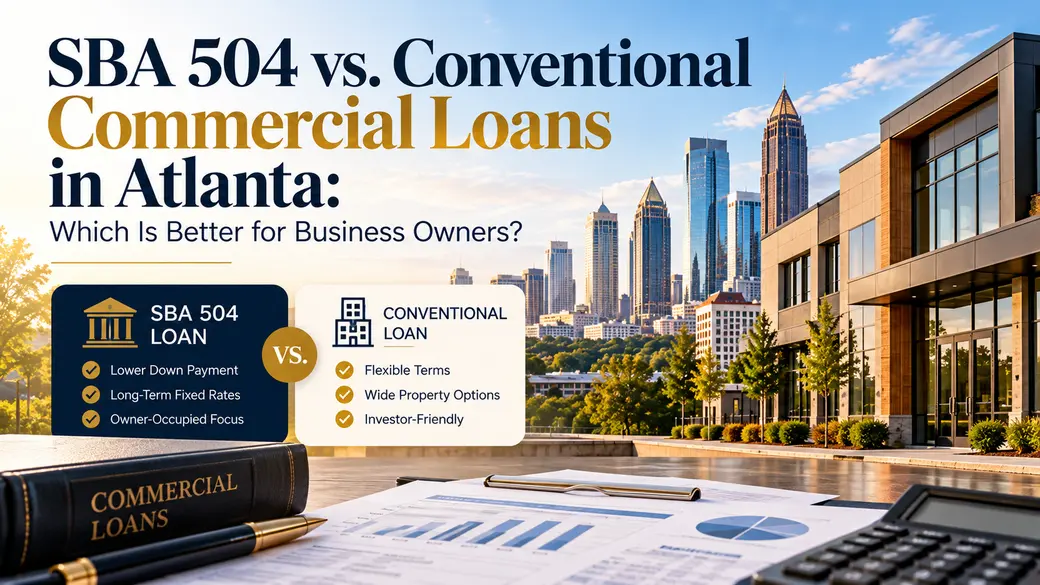
For an eligible business planning to occupy an Atlanta commercial property, an SBA 504 vs conventional commercial loan comparison often comes down to upfront equity, financing structure, and long-term flexibility. SBA 504 financing may preserve capital for qualifying owner-users, while conventional financing can fit investment-oriented or otherwise ineligible transactions. The choice affects repayment terms, borrowing costs, and operational planning for office buildings, retail spaces, warehouses, and other commercial properties. This practical comparison helps business owners evaluate financing options alongside their goals for buying commercial real estate in Atlanta.
What Is an SBA 504 Loan for Commercial Real Estate?
An SBA 504 loan helps eligible small businesses finance major fixed assets, including owner-occupied commercial real estate. A typical project combines a private senior lender, a Certified Development Company, or CDC, and borrower equity. A common structure includes at least 50% from the senior lender, up to 40% through the CDC/SBA-backed portion, and at least 10% from the borrower, subject to project-specific requirements.
The CDC-backed portion generally provides long-term fixed-rate financing, which can improve payment predictability for an operating business. Startups, special-purpose properties, and certain other projects may require higher borrower contributions. SBA 504 financing is generally intended for eligible operating businesses acquiring qualifying fixed assets, not passive commercial real estate investments. Review the official SBA 504 loan program. Program terms should be reconfirmed with the SBA, a participating lender, and a CDC because requirements may change.
How Do Conventional Commercial Real Estate Loans Work?
Conventional commercial real estate loans are lender-negotiated mortgages used to finance qualifying property purchases. Banks and other commercial lenders evaluate loan-to-value limits, borrower creditworthiness, business cash flow, debt-service coverage, property condition, and transaction risk. Depending on lender policies, conventional financing may support owner-occupied buildings as well as income-producing investment properties.
Terms are individually negotiated and may include fixed or variable interest rates, amortization periods, maturity dates, and potential balloon payments. This flexibility can help when a property type, ownership plan, or borrower profile does not fit SBA program rules. Conventional financing requirements vary by lender, asset class, financial qualifications, and the transaction’s overall risk profile. Buyers should compare written financing proposals rather than assume a conventional loan will always be more flexible or less costly.
SBA 504 vs. Conventional Commercial Loans: Key Differences
The following comparison summarizes SBA 504 program rules reviewed in October 2026 and lender-dependent conventional-loan terms.
| Financing Feature | SBA 504 Loan | Conventional Commercial Loan |
|---|---|---|
| Best Suited For | Eligible operating businesses acquiring qualifying fixed assets | Owner-occupied or investment transactions, subject to lender policy |
| Eligible Property Uses | Qualifying owner-occupied property, equipment, and improvements | Varies by lender, borrower, and property type |
| Typical Financing Structure | Senior lender, CDC/SBA-backed portion, and borrower equity | One commercial lender mortgage plus borrower equity |
| Borrower Equity Requirements | Often at least 10% for qualifying projects; higher contributions can apply | Varies by lender, loan-to-value, property, and borrower strength |
| Interest Rate Structure | CDC portion is generally long-term fixed rate | Fixed or variable, depending on negotiated terms |
| Repayment and Maturity Terms | CDC portion has long-term financing; bank terms are separately negotiated | Amortization and maturity are lender-specific; balloon payments may apply |
| Owner-Occupancy Requirements | Generally required under SBA program rules | May apply for some loans; investment financing may be available |
| Fees and Closing Considerations | CDC, SBA-related, lender, and closing costs may apply | Lender fees, third-party reports, and closing costs vary |
| Application and Approval Process | Requires coordination among lender, CDC, and borrower | Follows the individual lender’s underwriting process |
SBA 504 vs Conventional Commercial Loan - Step 1: Compare Down Payments and Equity Requirements
Borrower equity can be the most immediate difference in an SBA 504 vs conventional commercial loan decision. A qualifying SBA 504 project may permit a minimum 10% borrower contribution, helping an operating business retain capital for inventory, staffing, equipment, or other priorities. Startups, special-purpose properties, and other circumstances can require additional equity, so the projected structure should be confirmed early.
Conventional loan requirements depend on the lender, property type, financial qualifications, and loan-to-value limits. For planning purposes, a buyer might compare illustrative 20% and 25% down payment scenarios without treating either as a guaranteed term. Acquisition funds also extend beyond the equity contribution. Buyers should budget for closing expenses, professional fees, property improvements, environmental work, moving costs, and operating reserves. A realistic cost of buying commercial property in Atlanta accounts for each category before an offer is finalized.
SBA 504 vs Conventional Commercial Loan - Step 2: Understand Interest Rates, Loan Terms, and Long-Term Costs
Total financing cost matters more than the opening interest rate alone. In an SBA 504 project, the CDC-backed portion generally provides long-term fixed-rate financing, while the senior lender portion carries separately negotiated pricing, maturity, and repayment terms. That combination can offer useful payment predictability for an eligible owner-user, but every fee and obligation still requires review.
Conventional commercial mortgages may use fixed or variable rates, different amortization periods, and maturity dates that create a future refinancing decision. Buyers should compare origination charges, CDC fees, lender expenses, prepayment provisions, reserve requirements, and possible refinancing costs. Interest-rate conditions change, and neither loan type always produces the lowest total cost. Written lender estimates can show how payment stability, maturity exposure, and financing expenses apply to a specific Atlanta acquisition.
SBA 504 vs Conventional Commercial Loan - Step 3: Check SBA 504 Eligibility and Owner-Occupancy Requirements
SBA 504 financing is intended for eligible operating businesses, not ordinary passive commercial real estate investment acquisitions. Applicants must satisfy SBA size and business eligibility standards, demonstrate repayment ability, use proceeds for permitted purposes, and meet owner-occupancy requirements. For an existing-building acquisition, the operating business generally must occupy at least 51% of rentable space, while new construction involves different occupancy requirements under SBA guidance reviewed in October 2026.
The exact outcome depends on current program rules and the details of the transaction. Atlanta buyers should consider how office layouts, retail visibility, warehouse loading conditions, parking, building functionality, and future expansion plans affect both property selection and financing needs. Conventional financing may offer an alternative for investors or buyers who do not meet SBA requirements. Confirm eligibility with a participating lender and CDC before making financing commitments.
Example: Financing a $1 Million Commercial Property in Atlanta
A $1 million owner-occupied commercial property illustrates how initial equity can differ between a qualifying SBA 504 project and a conventional loan requiring a 25% down payment. This example compares the financing mix and buyer equity only. It does not predict approval, interest rates, payments, or total borrowing costs. Some SBA 504 projects require more than a 10% contribution, and conventional lender requirements vary by transaction. Closing costs, financing fees, property improvements, and cash reserves are not included.
Sample SBA 504 vs. Conventional Loan Financing Comparison
| Financing Component | Illustrative SBA 504 Structure | Illustrative Conventional Loan |
|---|---|---|
| Commercial property/project cost | $1,000,000 | $1,000,000 |
| Senior lender portion | $500,000 | N/A |
| CDC/SBA-backed portion | $400,000 | N/A |
| Conventional commercial loan | N/A | $750,000 |
| Borrower equity | $100,000 | $250,000 |
| Total buyer equity | $100,000 | $250,000 |
In this hypothetical comparison, the SBA 504 scenario requires $150,000 less initial equity than the conventional example, before other costs. It assumes a qualifying project with a 10% SBA 504 contribution and does not represent a guaranteed lending offer.
Step 4: Compare Application Requirements and Approval Processes
Both financing paths require organized business and property documentation. Buyers may need business financial statements, tax returns, credit information, property appraisals, environmental reviews, projected cash flow, purchase contracts, and supporting records. SBA 504 projects typically require coordination among the business owner, private lender, and CDC, while conventional commercial loans follow each lender’s underwriting procedures.
Property complexity, documentation completeness, lender workload, required evaluations, and underwriting questions can all affect the timeline. A warehouse conversion, specialized retail buildout, or office property with deferred maintenance can require added review. Buyers should begin lender discussions early and avoid assuming a guaranteed closing date. A commercial property due diligence checklist for Atlanta buyers can help organize property evaluations and clarify which reports may affect the purchase schedule.
Which Commercial Real Estate Loan Is Better for Your Atlanta Business?
The better commercial real estate loan is the one that fits the buyer’s eligibility, property use, cash position, and long-term ownership plan. SBA 504 financing may appeal to eligible owner-occupied businesses seeking long-term fixed-rate financing for qualifying fixed assets and potentially lower initial equity requirements. It can be especially relevant when retaining operating capital is a priority.
Conventional commercial loans may suit buyers seeking different structures, buyers with substantial available equity, or transactions outside SBA program eligibility. Investment-oriented purchases may also require conventional financing because SBA 504 is not structured for passive acquisitions. Compare property use, occupancy plans, cash reserves, business stability, repayment flexibility, maturity risk, and total financing costs. Current lending terms and borrower qualifications matter more than any broad claim that one program is universally superior. Review actual written proposals with qualified financing professionals before committing.
Compare Total Financing Costs, Not Just the Down Payment
Pro Tip: Compare the full loan structure before choosing financing solely because it requires a smaller down payment. Review interest expense, lender and CDC fees, prepayment provisions, reserve needs, maturity dates, and refinancing exposure. Written financing estimates from qualified lenders make it easier to compare the true cost, risk, and cash-flow implications of each option before committing to a commercial property acquisition.
Work With an Atlanta Commercial Real Estate Advisor
Commercial property selection and financing strategy should support the same operational plan, including location, building functionality, parking, loading access, occupancy needs, projected improvements, and ownership goals. Reviewing these factors together can help business owners narrow their options before entering negotiations.
Contact Danesha Ritzberg to discuss commercial property acquisition goals and the space requirements that may support your business plans.
Frequently Asked Questions About SBA 504 and Conventional Commercial Loans
What is the main difference between an SBA 504 loan and a conventional commercial loan?
SBA 504 uses a senior lender, CDC/SBA-backed financing, and borrower equity for qualifying owner-occupied projects. Conventional commercial loans are negotiated directly with individual lenders and can accommodate a broader range of ownership structures and property uses.
How much down payment is required for an SBA 504 commercial property loan?
Eligible SBA 504 projects may start with a 10% borrower contribution, subject to current program rules. Startups, special-purpose properties, and certain transaction circumstances can require more equity, so the proposed structure should be reviewed with a lender and CDC.
Can I use an SBA 504 loan to buy an investment property?
No, not for an ordinary passive investment acquisition. SBA 504 financing is designed for eligible operating businesses purchasing qualifying fixed assets and meeting owner-occupancy rules. Conventional commercial financing may better fit an investment-focused property purchase.
Are SBA 504 interest rates lower than conventional commercial loan rates?
Not automatically. Total borrowing cost depends on market conditions, the CDC-backed and senior-lender components, lender terms, fees, and prepayment provisions. A side-by-side review of written proposals is more useful than assuming either option will cost less.
How long does SBA 504 commercial real estate financing take?
SBA 504 timing depends on documentation, underwriting, CDC coordination, property requirements, and transaction complexity. A complete file can support a smoother process, but neither SBA 504 nor conventional financing carries a guaranteed approval or closing date.
Final Thoughts: Choosing the Right Commercial Property Financing in Atlanta
An SBA 504 vs conventional commercial loan decision should reflect eligibility, equity contributions, interest-rate structure, repayment terms, and total borrowing costs. SBA 504 may fit qualifying owner-occupied businesses, while conventional financing can better serve other ownership structures and property uses. Before selecting either option, business owners should evaluate their financial position, operational needs, and long-term plans for the property. Commercial property opportunities in Atlanta require a financing approach that supports both the building and the business operating within it.
Categories
Recent Posts




"My job is to find and attract mastery-based agents to the office, protect the culture, and make sure everyone is happy! "